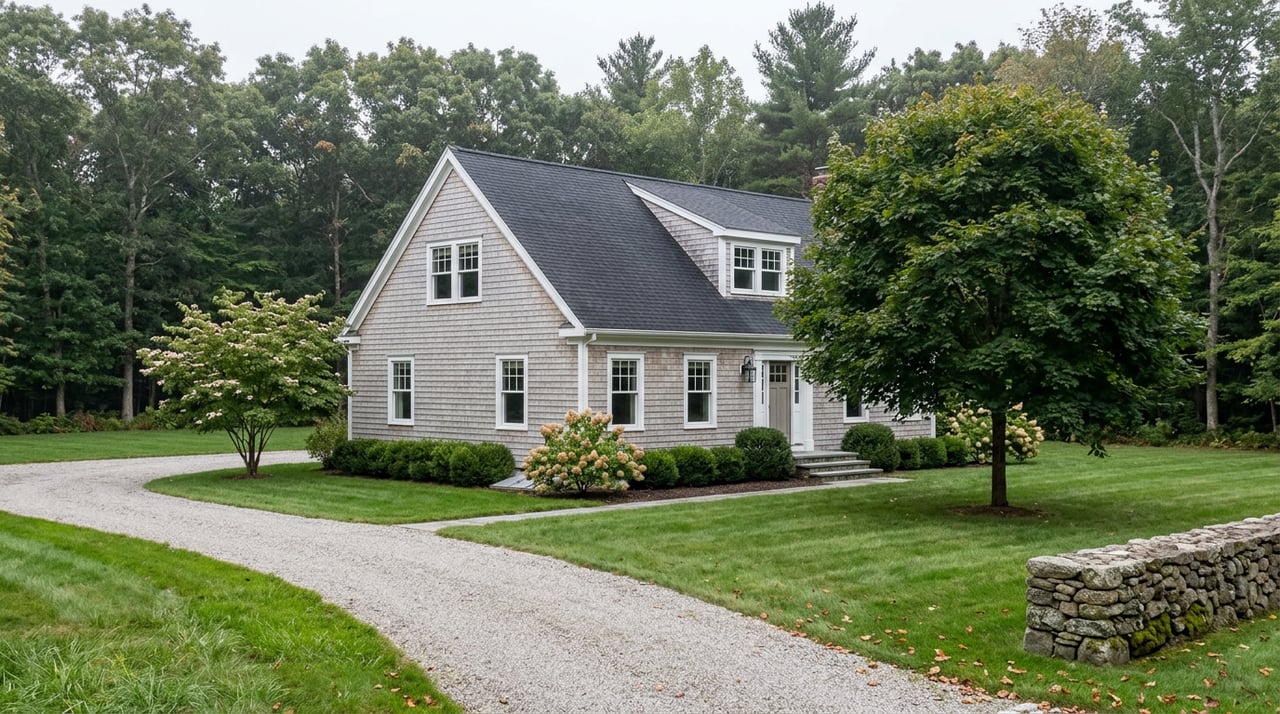
Weston CT Mill Rate: How Two-Acre Zoning Shapes Your Taxes
September 17, 2026
September 17, 2026
In May 2026, Weston's Board of Finance set the town's mill rate for the coming fiscal year at 24.57, a 2.8 percent increase over the prior year. The budget behind it, a $79.7 million package covering town operations and schools, passed by referendum with roughly 6 percent of registered voters turning out to decide it. First Selectwoman Samantha Nestor called the outcome a credit to Weston's town meeting form of government, where "everyone has a right to vote on the budget."
That's true, and it's also almost beside the point for someone comparing Weston to Westport, Fairfield, or Southport on a spreadsheet. The number that actually matters isn't how the rate got approved. It's why Weston's rate needs to climb almost every year regardless of who's on the Board of Finance or how the budget gets trimmed. That answer isn't in the budget documents. It's in the zoning map.
A mill rate is simple arithmetic once you know the pieces: the town divides its total budget by the assessed value of everything taxable in town, and the result is dollars owed per thousand dollars of assessed value. Connecticut law generally assesses property at 70 percent of fair market value, so a rate of 24.57 mills means $24.57 in tax for every $1,000 of that assessed value.
Weston's rate hasn't always sat here. Back in 2024, the town completed a revaluation that pushed the Grand List up 38.4 percent over the prior five years, driven by a 42.3 percent jump in real property values. That fresh, higher assessed value base is what let the Board of Finance drop the mill rate from 33.06 to 23.81 that year, even though most homeowners still saw their actual bills move depending on how their own assessment compared to the town average.
What's notable is what happened next. The revaluation gave Weston a bigger tax base to work with, and the rate still climbed the following cycle, to 24.57. According to the Board of Finance chair's own accounting, Weston's mill rate has grown at a compounded annual rate of 2.32 percent over the past three fiscal years. A fresh valuation didn't stop the upward drift. It just reset the starting point.
Here's the mechanism that explains why. Weston's zoning code, on file with the town, places nearly the entire residential footprint of the town into a single district called R-2A, the Two Acre Residential and Farming District. Weston's zoning code sets out specific rules:
That's a town built, by design, around low density. It preserves privacy and rural character, which is precisely what draws a certain kind of buyer to Weston in the first place. But it also means there is almost nothing else on the Grand List to absorb a budget increase. According to the Connecticut Conference of Municipalities' data hub, Weston's entire commercial core amounts to a single Town Center: a grocery store, a bank, a dry cleaner, a post office, a spirits shop, one restaurant, and a gas station, all within walking distance of Town Hall. That's not a gap in the data. That is the commercial tax base.
When a town's spending goes up and there's no meaningful commercial, industrial, or apartment segment to share the load, residential owners carry essentially all of it. That's not a policy choice the current Board of Finance is making. It's the arithmetic that two-acre zoning has been building toward since long before this budget cycle.
Compare that to Westport, which completed its own revaluation on a similar timeline. Westport's 2025 Grand List, signed and released in early 2026, showed residential real estate values rising 60 percent while commercial values rose only 16 percent, a gap driven partly by employers like Bridgewater Associates, whose Nyala Farm campus didn't appreciate at anywhere near the pace of the surrounding homes. Westport homeowners are absolutely feeling their own version of this squeeze, and a local analysis of that town's revaluation made the case that most residents would still pay more even with a lower headline mill rate.
But Westport has a commercial and institutional base large enough to matter in the equation at all. Weston, by design, doesn't. There's no equivalent to a Nyala Farm sitting on Weston's Grand List to share the load when spending rises. That leaves Weston more exposed to each increase in spending than Westport.
This isn't a knock on either town. Westport and Weston made different tradeoffs decades ago, and both are living with the consequences today. It's simply a different answer to the same question a buyer is really asking when they look at a mill rate: what is this number actually built on.
If you're weighing Weston against a neighboring town using tax rate as a shorthand for cost, a few things are worth carrying into that comparison:
The rate itself tells you less than the base it's dividing into. A high mill rate on a town with almost no commercial tax base behaves very differently over time than the same rate on a town with employers, retail, and mixed-use development sharing the bill. Weston's structure means residential owners carry essentially all of it, and will continue to as long as the zoning stays as it is.
Recent history suggests the direction is more predictable than any single year's headline. A revaluation can reset the rate downward once, but the underlying spending pressure, cited by the Board of Finance itself as accelerating health insurance premiums, rising energy costs, and infrastructure projects like the North House HVAC upgrade already in motion, tends to push it back up afterward. Three years of compounded growth at 2.32 percent isn't dramatic in any single cycle, but it compounds the same way any other rate does.
For anyone weighing a renovation or new build on a Weston lot, the same zoning rules that shape the tax base also shape what you can do with the land itself. A 15 percent coverage cap and 30 to 50 foot setbacks mean the acreage you're buying isn't the acreage you're building on, and that's worth factoring into any project budget before permits are pulled.
None of this makes Weston a harder or easier sell than its neighbors. It makes it a different kind of asset, one where the tax line is the direct cost of the privacy and density restrictions the town has chosen to protect. A buyer who understands that going in isn't surprised by the annual bill. A buyer who compares Weston to Westport on mill rate alone is comparing two different kinds of towns as if they were the same kind of math.
Does two-acre zoning cover all of Weston? Most of the town's residential land sits in the R-2A district, but there are small exceptions, including the Neighborhood Shopping Center District at the Town Center and a Village District. The commercial footprint across all of these combined is still small relative to the town's total acreage.
Will Weston's mill rate keep rising every year? Based on the last three fiscal years, gradual increases have been more common than decreases outside of a revaluation year. The Board of Finance has pointed to rising insurance and energy costs and infrastructure spending as ongoing pressures on future budgets.
Does a higher mill rate always mean a higher tax bill? Not directly. Your bill is based on your assessed value multiplied by the mill rate and divided by 1,000, so a lower rate paired with a much higher assessment can still raise what you owe. Weston's own 2024 revaluation showed roughly half of homeowners seeing lower net taxes and half seeing higher ones under the same new rate, depending entirely on how their individual assessment moved.
If you're weighing a move to Weston, or comparing it against another Gold Coast town on tax rate alone, it helps to have someone who can walk through what a specific property's numbers actually mean before you make an offer. Elizabeth Altobelli works with buyers and sellers across Fairfield County's Gold Coast towns every day. Request a complimentary home valuation to start with the real numbers for your situation, not just the headline rate.
This article is general information, not legal, tax or financial advice. Consult a qualified professional about your situation.
Stay up to date on the latest real estate trends.
With extensive experience and expertise, Elizabeth is well-equipped to navigate this complex market, negotiating with her client's best interests in mind. She holds great reverence for the successful family business, which led to her joining William Raveis.
Get In Touch With Me To Learn More
Elizabeth Altobelli
2525 Post Road Southport, CT 06890